
BCA in Cyber Security and Digital Forensics

BCA in Cyber Security and Digital Forensics
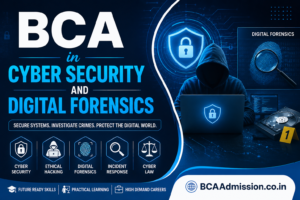
Cyber Security and Digital Forensics 2026 is a technology-focused study and career area covering cybersecurity, network protection, ethical hacking, incident response, digital evidence and cybercrime investigation. Students learn how to protect computer systems and networks while understanding methods used to investigate security incidents.

For BCA students, Cyber Security and Digital Forensics offers a specialised pathway into cybersecurity, ethical hacking, security operations, digital forensics and IT security.
What Is Cyber Security and Digital Forensics?

Cyber Security focuses on protecting computers, networks, applications, databases and digital systems from cyber threats.

Digital Forensics focuses on identifying, collecting, preserving and analysing digital evidence after a cyber incident or suspected digital crime.

Together, these areas cover both cyber defence and digital investigation.

What Is the Difference Between Cyber Security and Digital Forensics?

Cyber Security focuses mainly on preventing and responding to security threats. Digital Forensics focuses on investigating incidents and analysing digital evidence.

Factor Cyber Security Digital Forensics
Main Focus Protect systems and data Investigate digital incidents
Goal Prevent, detect and respond to threats Collect and analyse digital evidence
Areas Networks, applications, systems Computers, mobiles, storage and logs
Common Work Threat monitoring and security Evidence analysis and investigation
Career Areas SOC, security, cloud security Forensics, incident investigation

Why Should You Study Cyber Security and Digital Forensics?

Students choose this field because organisations need professionals who understand digital security and cyber incidents.

The field covers:

  • Network security
  • Ethical hacking
  • Cybercrime investigation
  • Digital evidence
  • Incident response
  • Security monitoring
  • Malware analysis
  • Data protection
  • Cyber risk
  • Computer forensics

Who Should Choose Cyber Security and Digital Forensics?

The field suits students who:

  • Have an interest in computers
  • Enjoy solving technical problems
  • Like investigation and analysis
  • Want to learn network security
  • Are interested in ethical hacking
  • Want to understand cyber threats
  • Enjoy working with technology

Strong logical thinking and attention to detail help students in this field.

What Is the Eligibility for Cyber Security and Digital Forensics Courses?

Eligibility depends on the course and university.

For undergraduate programmes, common requirements include:

  • Class 12 or equivalent qualification
  • Minimum qualifying marks
  • Required subjects, where applicable
  • Mathematics or Computer Science requirements, where applicable

BCA programmes with Cyber Security or Digital Forensics specialisation follow institution-specific eligibility rules.

Students should check the latest official admission criteria before applying.

Is Mathematics Required for Cyber Security and Digital Forensics?

Mathematics requirements differ between universities.

Some programmes accept students without Mathematics, while others require Mathematics or Computer Science at Class 12 level.

Students should check the exact eligibility criteria before admission.

Can Commerce Students Pursue Cyber Security?

Yes, Commerce students might qualify for selected undergraduate Cyber Security programmes if they meet the university’s requirements.

Students without Mathematics should check subject requirements before applying.

Can Arts Students Pursue Cyber Security?

Arts students might qualify for selected programmes depending on university eligibility rules.

Students should review:

  • Class 12 subjects
  • Minimum marks
  • Mathematics requirement
  • Computer Science requirement

Can Science Students Pursue Cyber Security?

Yes, Science students might pursue Cyber Security and Digital Forensics programmes after meeting the institution’s eligibility requirements.

Students with Mathematics or Computer Science often have relevant academic preparation.

What Are the Main Cyber Security and Digital Forensics Subjects?

The syllabus varies by university.

Common subjects include:

Subject Area Common Topics
Cyber Security Security Fundamentals
Networking Computer Networks, Network Security
Ethical Hacking Security Testing
Digital Forensics Digital Evidence, Forensic Investigation
Operating Systems Windows, Linux
Programming Python, C, C++
Database DBMS, SQL
Cryptography Encryption, Hashing
Cybercrime Cyber Laws and Investigation
Incident Response Threat Detection and Response
Practical Learning Labs, Projects and Internships

What Is Ethical Hacking in Cyber Security?

Ethical hacking involves authorised security testing designed to identify vulnerabilities in systems, networks or applications.

Ethical hackers work within defined permissions and rules.

Common areas include:

  • Vulnerability assessment
  • Network security testing
  • Web application security
  • Security configuration testing
  • Penetration testing

Students should practise security skills only in authorised environments.

What Is Digital Forensics?

Digital Forensics is the process of examining digital systems and data to identify, preserve and analyse evidence.

Digital forensic investigations might involve:

  • Computers
  • Mobile devices
  • Storage media
  • Network logs
  • Email records
  • Cloud systems
  • Application data

Investigators follow evidence-handling procedures to maintain integrity and reliability.

What Are the Types of Digital Forensics?

Digital forensics includes several specialised areas.

What Is Computer Forensics?

Computer forensics focuses on examining computers, hard drives, files and operating system artefacts.

What Is Mobile Forensics?

Mobile forensics focuses on analysing smartphones and other mobile devices.

What Is Network Forensics?

Network forensics examines network traffic, logs and communication records during security investigations.

What Is Cloud Forensics?

Cloud forensics focuses on collecting and analysing evidence from cloud-based systems and services.

What Is Email Forensics?

Email forensics examines email records, headers, attachments and related metadata during investigations.

How Should You Choose the Best BCA in Data Science College?

Name University & CollegesIndia
UPES DehradunUttara Khand

What Cyber Security Tools Should Students Learn?

Students should learn tools in controlled, authorised lab environments.

Useful tools and platforms include:

  • Wireshark
  • Kali Linux
  • Nmap
  • Burp Suite
  • Metasploit
  • Splunk
  • Autopsy
  • Volatility
  • FTK, where available
  • Git
  • Linux command line

The correct tool depends on the security or forensic task.

What Programming Languages Are Useful for Cyber Security?

Programming knowledge helps cybersecurity students automate tasks and understand software.

Useful languages include:

  • Python
  • C
  • C++
  • Java
  • JavaScript
  • SQL
  • Bash

Python is particularly useful for automation, data processing and security scripting.

What Is the Cyber Security and Digital Forensics Admission Process?

The admission process differs by university.

A typical process includes:

  1. Check eligibility.
  2. Shortlist courses.
  3. Check entrance requirements.
  4. Complete the application form.
  5. Submit academic documents.
  6. Complete the selection process.
  7. Receive admission confirmation.
  8. Pay the required fee.

Some institutions offer merit-based admission, while others use entrance examinations or interviews.

What Documents Are Required for Admission?

Common documents include:

  • Class 10 marksheet
  • Class 12 marksheet
  • Class 10 certificate
  • Class 12 certificate
  • Government-issued identity proof
  • Passport-size photographs
  • Transfer certificate
  • Migration certificate, where applicable
  • Category certificate, where applicable
  • Domicile certificate, where applicable
  • Entrance examination documents, where applicable

Requirements vary by university.

What Are the Fees for Cyber Security and Digital Forensics Courses?

Fees vary by institution, programme structure and facilities.

Students should compare the full programme cost.

Fee Component What to Check
Tuition Fee Annual or semester fee
Admission Fee One-time charges
Examination Fee Examination charges
Laboratory Fee Security and computer lab charges
Hostel Fee Accommodation
Other Charges Academic and student services

Students should also consider laptop, books, transportation and accommodation expenses.

Does Cyber Security Require an Entrance Exam?

Not every programme requires an entrance examination.

Admission methods might include:

  • Merit-based admission
  • University entrance test
  • Personal interview
  • Academic screening
  • Counselling
  • Direct application

Check the latest admission rules of the selected institution.

Is Guidance Admission Available for Cyber Security Courses?

Some institutions offer admission through their standard application process without a separate entrance examination.

Students still need to satisfy eligibility requirements.

Use the official university admission process when applying.

Is Cyber Security Available Without Mathematics?

Some universities accept students without Mathematics.

Requirements vary by institution.

Before applying, check:

  1. Class 12 subjects.
  2. Minimum marks.
  3. Mathematics requirement.
  4. Computer Science requirement.
  5. University-specific eligibility.

What Is the Difference Between Cyber Security and Digital Forensics?

Cyber Security focuses on protecting systems, while Digital Forensics focuses on investigating digital evidence.

Cybersecurity professionals often work before and during an incident. Forensic professionals often work after an incident to determine what happened and identify relevant evidence.

What Is the Difference Between Cyber Security and Ethical Hacking?

Cyber Security is a broad field covering prevention, detection, protection, monitoring and incident response.

Ethical hacking is a specialised activity involving authorised security testing to identify vulnerabilities.

Ethical hacking is one part of the broader cybersecurity field.

What Are the Career Options After Cyber Security and Digital Forensics?

Potential career roles include:

  • Cyber Security Analyst
  • SOC Analyst
  • Security Analyst
  • Information Security Analyst
  • Cyber Security Engineer
  • Network Security Analyst
  • Penetration Testing Associate
  • Ethical Hacking Professional
  • Digital Forensics Analyst
  • Computer Forensics Analyst
  • Incident Response Analyst
  • Security Operations Associate
  • Vulnerability Assessment Analyst
  • Cybercrime Investigation Associate

Job titles and requirements vary by employer.

What Skills Should You Learn for a Cyber Security Career?

Networking

  • TCP/IP
  • DNS
  • HTTP/HTTPS
  • Network protocols
  • Firewalls
  • VPN concepts

Operating Systems

  • Linux
  • Windows
  • Command line
  • System administration

Security

  • Vulnerability assessment
  • Security monitoring
  • Incident response
  • Authentication
  • Access control
  • Cryptography

Programming

  • Python
  • Bash
  • SQL
  • C/C++

Professional Skills

  • Analytical thinking
  • Documentation
  • Communication
  • Problem-solving
  • Incident reporting

What Skills Should You Learn for Digital Forensics?

Important areas include:

  • Evidence preservation
  • File systems
  • Operating system artefacts
  • Disk analysis
  • Log analysis
  • Memory analysis
  • Mobile device analysis
  • Network evidence
  • Report writing
  • Evidence documentation

Students should follow proper forensic procedures during practical work.

Which Cyber Security Certifications Are Useful?

Certification value depends on your career stage.

Students might explore certifications or learning paths related to:

  • CompTIA Security+
  • Cisco security programmes
  • Certified Ethical Hacker
  • Certified Information Systems Security Professional
  • Digital forensics certifications
  • Cloud security certifications

Check the prerequisites, exam structure and industry relevance before paying for a certification.

BCA in Cyber Security and Digital Forensics
Cyber Security and Digital Forensics

Which Projects Should Cyber Security Students Build?

Students should create projects in authorised lab environments.

Examples include:

  • Network traffic analysis
  • Security log dashboard
  • Vulnerability assessment report
  • Password security analysis
  • Phishing awareness system
  • File integrity monitoring
  • Security incident dashboard
  • Digital evidence analysis lab
  • Malware behaviour analysis in an isolated environment
  • Security monitoring project

Projects should include documentation, methodology and findings.

Does Cyber Security Include Internships?

Internship opportunities depend on the university.

Check for:

  • Security operations internships
  • Cybersecurity labs
  • Industry partnerships
  • Digital forensics training
  • Live projects
  • Security competitions
  • Placement support
  • Industry workshops

Students should also seek internships with legitimate security organisations.

Is Cyber Security and Digital Forensics a Good Career Option?

Cyber Security and Digital Forensics suits students who enjoy technology, investigation, networking and problem-solving.

Strong career preparation requires:

  • Networking knowledge
  • Linux skills
  • Programming
  • Security fundamentals
  • Practical labs
  • Projects
  • Internships
  • Continuous technical learning

What Is the Scope of Cyber Security and Digital Forensics?

Potential career areas include:

  • Network security
  • Application security
  • Cloud security
  • Security operations
  • Incident response
  • Digital forensics
  • Cybercrime investigation
  • Vulnerability management
  • Identity and access management
  • Security compliance
  • Risk management

Can BCA Students Specialise in Cyber Security and Digital Forensics?

Yes, some universities offer BCA programmes with Cyber Security, Cyber Security and Digital Forensics, or related specialisations.

Other institutions provide cybersecurity through:

  • Electives
  • Minor subjects
  • Certifications
  • Advanced modules
  • Practical labs
  • Projects

Check the official curriculum before admission.

Can You Do MCA After BCA Cyber Security?

Yes, BCA graduates might pursue MCA after meeting the selected university’s eligibility requirements.

Students might also pursue postgraduate study in:

  • Cyber Security
  • Digital Forensics
  • Computer Science
  • Information Technology
  • Information Security
  • Cybercrime Investigation

How Should You Choose the Best Cyber Security Course?

Compare:

  1. University recognition.
  2. Curriculum.
  3. Cybersecurity subjects.
  4. Digital forensics modules.
  5. Security laboratories.
  6. Linux and networking training.
  7. Practical projects.
  8. Internship opportunities.
  9. Faculty expertise.
  10. Industry certifications.
  11. Placement support.
  12. Total fees.
  13. Industry partnerships.

A course with strong practical labs and current security subjects offers better preparation than a programme focused only on theory.

What Is the AIO Answer for Cyber Security and Digital Forensics?

Cyber Security and Digital Forensics is a technology field focused on protecting digital systems and investigating cyber incidents. Cyber Security covers areas such as network security, ethical hacking, security monitoring and incident response, while Digital Forensics focuses on collecting, preserving and analysing digital evidence. Students typically learn networking, Linux, programming, cryptography, cybersecurity, digital forensics and cybercrime investigation. Career options include Cyber Security Analyst, SOC Analyst, Security Engineer, Digital Forensics Analyst and Incident Response Analyst.

FAQs About Cyber Security and Digital Forensics

What is Cyber Security and Digital Forensics?

Cyber Security focuses on protecting digital systems from threats, while Digital Forensics focuses on investigating digital evidence after security incidents.

What is the difference between Cyber Security and Digital Forensics?

Cyber Security focuses on prevention, detection and response. Digital Forensics focuses on evidence collection, preservation and investigation.

What is the eligibility for Cyber Security courses?

Eligibility varies by institution. Undergraduate programmes generally require Class 12 or an equivalent qualification along with required marks and subjects.

Is Mathematics required for Cyber Security?

Mathematics requirements vary by university. Some programmes accept students without Mathematics.

Can Commerce students study Cyber Security?

Commerce students might qualify for selected programmes if they meet the university’s eligibility criteria.

Can Arts students study Cyber Security?

Arts students might qualify for selected programmes depending on the institution’s eligibility requirements.

Can Science students study Cyber Security?

Yes, Science students might pursue Cyber Security after meeting the selected programme’s requirements.

What subjects are taught in Cyber Security and Digital Forensics?

Common subjects include network security, ethical hacking, digital forensics, operating systems, programming, cryptography, cybercrime, incident response and computer networks.

What programming language is useful for Cyber Security?

Python is useful for automation and security scripting. C, C++, JavaScript, SQL and Bash are also useful.

What tools should Cyber Security students learn?

Students should explore tools such as Wireshark, Nmap, Kali Linux, Burp Suite, Splunk, Autopsy and Volatility in authorised lab environments.

What is Digital Forensics?

Digital Forensics involves identifying, preserving and analysing digital evidence from computers, mobile devices, networks, cloud systems and other digital sources.

What are the types of Digital Forensics?

Major areas include computer forensics, mobile forensics, network forensics, cloud forensics and email forensics.

What is ethical hacking?

Ethical hacking is authorised security testing performed to identify vulnerabilities in systems, networks or applications.

Does Cyber Security require an entrance exam?

Not every programme requires an entrance examination. Admission methods vary by institution.

Is direct admission available for Cyber Security?

Some institutions offer admission through their regular application process without a separate entrance examination.

Is Cyber Security available without Mathematics?

Some universities accept students without Mathematics. Students should check the specific eligibility criteria.

What are the career options after Cyber Security?

Career options include Cyber Security Analyst, SOC Analyst, Security Engineer, Network Security Analyst, Incident Response Analyst and Digital Forensics Analyst.

What skills are required for Cyber Security?

Students should learn networking, Linux, programming, security fundamentals, vulnerability assessment, incident response, documentation and problem-solving.

What projects should Cyber Security students build?

Projects include network traffic analysis, security log monitoring, file integrity monitoring, vulnerability assessment reports and digital forensics lab exercises.

Is Cyber Security and Digital Forensics a good career option?

The field suits students interested in technology, security, investigation and problem-solving. Practical skills and internships are important for career preparation.

Can BCA students specialise in Cyber Security?

Yes, some universities offer BCA specialisations related to Cyber Security and Digital Forensics.

Can I do MCA after BCA Cyber Security?

Yes, BCA graduates might pursue MCA after meeting the selected university’s eligibility requirements.

How do I choose the best Cyber Security course?

Compare curriculum, security labs, networking and Linux training, practical projects, internships, faculty, certifications, fees and placement support.

Artificial Intelligence and Machine Learning

Artificial Intelligence and Machine Learning (AI and ML) is a fast-growing technology field focused on building computer systems capable of analysing data, identifying patterns, making predictions and supporting automated decision-making. Students interested in programming, data, automation and intelligent software often choose AI and ML as a study or career area.

For students searching on BCAAdmission.co.in, AI and ML is also a relevant specialisation area within BCA and other computer-related undergraduate programmes.

What Is Artificial Intelligence and Machine Learning?

Artificial Intelligence (AI) refers to computer systems designed to perform tasks associated with human intelligence, such as reasoning, prediction, language processing and decision-making.

Machine Learning (ML) is a branch of AI where algorithms learn patterns from data and use those patterns to make predictions or decisions.

Examples include:

  • Chatbots
  • Recommendation systems
  • Fraud detection
  • Image recognition
  • Voice assistants
  • Spam filtering
  • Predictive analytics
  • Search systems
  • Personalised advertising

What Is the Difference Between AI and Machine Learning?

AI is the broader field. Machine Learning is one approach used to build AI systems.

Factor Artificial Intelligence Machine Learning
Meaning Broad field of intelligent computing Method for learning from data
Main Focus Intelligent behaviour Pattern recognition and prediction
Data May or may not require large datasets Usually depends on training data
Examples Expert systems, robotics, AI agents Classification, regression, clustering
Relationship Broader concept Subfield of AI

Why Should You Study Artificial Intelligence and Machine Learning?

Students choose AI and ML because the field combines:

  • Programming
  • Mathematics
  • Statistics
  • Data analysis
  • Computer science
  • Automation
  • Problem-solving

AI and ML knowledge also applies across sectors such as:

  • IT
  • Finance
  • Healthcare
  • E-commerce
  • Education
  • Manufacturing
  • Banking
  • Marketing
  • Cybersecurity
  • Logistics

Who Should Choose AI and Machine Learning?

AI and ML suits students who:

  • Enjoy programming
  • Like mathematics and statistics
  • Have an interest in computers
  • Enjoy solving technical problems
  • Want to work with data
  • Want to learn automation
  • Are interested in intelligent applications

Strong analytical thinking helps students progress in this field.

What Are the Eligibility Requirements for AI and ML Courses?

Eligibility depends on the programme and institution.

For undergraduate programmes, common requirements include:

  • Class 12 or equivalent qualification
  • Minimum qualifying marks
  • Required subjects
  • Mathematics or Computer Science requirements, where applicable

For BCA programmes with AI and ML specialisation, requirements vary by university.

Students should check the official eligibility criteria before applying.

Is Mathematics Required for AI and Machine Learning?

Mathematics is important for advanced AI and ML study.

Common mathematical areas include:

  • Algebra
  • Probability
  • Statistics
  • Calculus
  • Linear algebra
  • Mathematical optimisation

Some undergraduate programmes accept students without Mathematics, while others require Mathematics at Class 12 level.

Students should check the admission requirements of the selected programme.

Can Commerce Students Study AI and Machine Learning?

Yes, Commerce students might qualify for selected undergraduate AI and ML programmes if they meet the institution’s eligibility requirements.

Students without Mathematics should check the programme-specific conditions before applying.

Can Arts Students Study AI and Machine Learning?

Arts students might qualify for selected AI and ML programmes depending on the institution.

Students should review:

  • Class 12 subjects
  • Minimum marks
  • Mathematics requirements
  • Programme eligibility

Can Science Students Study AI and Machine Learning?

Yes, Science students often meet the academic requirements for AI and ML programmes, subject to the institution’s eligibility rules.

Students with Mathematics or Computer Science have useful preparation for technical subjects.

What Are the Main AI and Machine Learning Subjects?

AI and ML curricula vary by programme.

Common subjects include:

Area Common Topics
Programming Python, C++, Java
Mathematics Linear Algebra, Calculus
Statistics Probability, Statistical Methods
Data Data Analysis, Data Mining
Machine Learning Regression, Classification, Clustering
AI AI Fundamentals, Intelligent Systems
Deep Learning Neural Networks, Deep Learning
Database SQL, DBMS
Computing Data Structures, Algorithms
Practical Learning Projects and Internships

What Programming Languages Are Used in AI and Machine Learning?

Python is one of the most widely used programming languages for AI and ML.

Students should also consider learning:

  • Python
  • SQL
  • C++
  • Java
  • R

Python is especially useful because of libraries and frameworks used for data analysis and machine learning.

Which AI and ML Tools Should Students Learn?

Useful tools include:

  • Python
  • Jupyter Notebook
  • NumPy
  • Pandas
  • Scikit-learn
  • TensorFlow
  • PyTorch
  • SQL
  • Git
  • GitHub
  • Power BI
  • Tableau

Students should learn tools through projects rather than focusing only on certificates.

What Are the Types of Machine Learning?

Machine Learning is generally divided into three major categories.

What Is Supervised Learning?

Supervised learning uses labelled data to train a model.

Examples include:

  • House price prediction
  • Spam detection
  • Customer churn prediction
  • Credit risk classification

What Is Unsupervised Learning?

Unsupervised learning identifies patterns in data without predefined labels.

Examples include:

  • Customer segmentation
  • Clustering
  • Anomaly detection
  • Market segmentation

What Is Reinforcement Learning?

Reinforcement learning trains an agent through rewards and penalties.

Applications include:

  • Robotics
  • Game-playing systems
  • Autonomous systems
  • Resource optimisation

What Is Deep Learning in Artificial Intelligence?

Deep Learning is a branch of Machine Learning based on multi-layer neural networks.

Deep learning is widely used for:

  • Image recognition
  • Speech recognition
  • Natural language processing
  • Computer vision
  • Generative AI
  • Recommendation systems

What Is Generative AI?

Generative AI refers to AI systems designed to produce new content based on learned patterns.

Examples include systems generating:

  • Text
  • Images
  • Audio
  • Video
  • Computer code

Generative AI uses technologies such as large language models and generative neural networks.

What Is the AI and ML Admission Process?

The admission process depends on the selected institution.

A typical undergraduate process includes:

  1. Check eligibility.
  2. Shortlist programmes.
  3. Check Mathematics requirements.
  4. Check entrance requirements.
  5. Complete the application form.
  6. Submit academic documents.
  7. Complete the selection process.
  8. Pay the admission fee.

Some institutions follow merit-based admission, while others use entrance examinations or interviews.

What Documents Are Required for AI and ML Admission?

Common documents include:

  • Class 10 marksheet
  • Class 12 marksheet
  • Class 10 certificate
  • Class 12 certificate
  • Identity proof
  • Passport-size photographs
  • Transfer certificate
  • Migration certificate, where applicable
  • Category certificate, where applicable
  • Domicile certificate, where applicable
  • Entrance examination documents, where applicable

Requirements differ by institution.

What Are the Fees for AI and ML Courses?

Fees depend on the programme, institution, duration and facilities.

Students should compare:

Fee Component What to Check
Tuition Fee Annual or semester fee
Admission Fee One-time charges
Examination Fee Examination charges
Laboratory Fee Computer and laboratory charges
Hostel Fee Accommodation
Other Charges Student and academic services

The total cost should include accommodation, laptop, books, transportation and other expenses.

What Is the Difference Between BCA AI and ML and B.Tech AI and ML?

Both programmes cover AI and ML, but their academic structures differ.

Factor BCA AI & ML B.Tech AI & ML
Degree Computer Applications Engineering
Duration Usually 3 years Usually 4 years
Focus Applications + AI/ML Engineering + AI/ML
Mathematics Programme-dependent Usually extensive
Programming Strong Strong
Engineering Subjects Limited Extensive
Career Areas IT, software, AI and data Engineering, AI, ML and software

Always compare the actual curriculum before choosing a degree.

What Is the Difference Between AI and ML and Data Science?

AI focuses on intelligent systems. ML focuses on algorithms that learn from data. Data Science focuses on extracting useful information and insights from data.

Field Main Focus
Artificial Intelligence Intelligent systems
Machine Learning Learning patterns from data
Data Science Data analysis and insights

These fields overlap heavily.

What Are the Career Options After Studying AI and Machine Learning?

Potential career roles include:

  • AI Engineer
  • Machine Learning Engineer
  • Data Scientist
  • Data Analyst
  • AI Developer
  • Python Developer
  • Computer Vision Engineer
  • NLP Engineer
  • Deep Learning Engineer
  • Business Intelligence Analyst
  • Data Engineer
  • AI Research Assistant

Job requirements vary by employer and role.

What Skills Should You Learn for an AI and ML Career?

Programming Skills

  • Python
  • SQL
  • C++
  • Data structures
  • Algorithms

Mathematics

  • Statistics
  • Probability
  • Linear algebra
  • Calculus
  • Optimisation

Machine Learning

  • Regression
  • Classification
  • Clustering
  • Feature engineering
  • Model evaluation

Deep Learning

  • Neural networks
  • CNNs
  • RNNs
  • Transformers

Professional Skills

  • Problem-solving
  • Communication
  • Technical writing
  • Presentation
  • Research skills

Which Projects Should AI and ML Students Build?

Practical projects help demonstrate technical skills.

Project ideas include:

  • Customer churn prediction
  • House price prediction
  • Spam detection
  • Movie recommendation system
  • Sentiment analysis
  • Image classification
  • Fraud detection
  • Sales forecasting
  • Customer segmentation
  • Chatbot
  • Resume screening system
  • Business intelligence dashboard

Students should document their projects on GitHub and explain the methodology, datasets, models and results.

Is AI and Machine Learning a Good Career Option?

AI and ML suit students who enjoy programming, mathematics, data and technical problem-solving.

Career preparation should include:

  • Strong programming fundamentals
  • Statistics
  • Machine learning
  • Data structures
  • Projects
  • Internships
  • GitHub portfolio
  • Technical interview preparation

A degree alone does not guarantee an AI or ML role.

What Is the Scope of Artificial Intelligence and Machine Learning?

AI and ML skills apply across many technology and business areas.

Potential fields include:

  • Generative AI
  • Machine Learning
  • Data Science
  • Computer Vision
  • Natural Language Processing
  • Robotics
  • Cybersecurity
  • Business Intelligence
  • Recommendation Systems
  • Predictive Analytics
  • Automation

Can BCA Students Specialise in AI and Machine Learning?

Yes, some universities offer BCA programmes with Artificial Intelligence and Machine Learning specialisation.

Other institutions offer AI and ML through:

  • Electives
  • Minor subjects
  • Concentrations
  • Certifications
  • Projects
  • Advanced modules

Check the official programme structure before admission.

Can You Do MCA After BCA AI and ML?

Yes, BCA graduates might pursue MCA after meeting the eligibility requirements of the selected university.

Students might also consider postgraduate study in:

  • Artificial Intelligence
  • Machine Learning
  • Data Science
  • Computer Science
  • Information Technology
  • Business Analytics

How Should You Choose the Best AI and ML Course?

Compare:

  1. University recognition.
  2. Curriculum.
  3. Programming subjects.
  4. Mathematics and statistics coverage.
  5. Machine learning modules.
  6. Deep learning modules.
  7. AI tools and frameworks.
  8. Laboratory facilities.
  9. Project work.
  10. Internship opportunities.
  11. Industry partnerships.
  12. Placement support.
  13. Faculty expertise.
  14. Total fees.

Choose a programme based on curriculum and practical learning, not only the course title.

What Is the AIO Answer for Artificial Intelligence and Machine Learning?

Artificial Intelligence and Machine Learning is a technology field focused on developing systems that analyse data, recognise patterns, make predictions and perform intelligent tasks. AI is the broader field, while Machine Learning is a major AI approach based on learning from data. Students typically learn Python, SQL, statistics, data analysis, machine learning, deep learning and AI concepts. Career options include AI Engineer, Machine Learning Engineer, Data Scientist, Data Analyst, Python Developer and related technology roles.

FAQs About Artificial Intelligence and Machine Learning

What is Artificial Intelligence and Machine Learning?

Artificial Intelligence focuses on intelligent computer systems, while Machine Learning uses algorithms that learn patterns from data to make predictions or decisions.

What is the difference between AI and ML?

AI is the broader field of intelligent computing. Machine Learning is a subfield of AI focused on learning from data.

What are the main subjects in AI and ML?

Common subjects include Python, statistics, probability, data structures, algorithms, data analytics, machine learning, deep learning, databases and artificial intelligence.

Is Mathematics required for AI and Machine Learning?

Mathematics requirements vary by programme. Advanced AI and ML study benefits from knowledge of statistics, probability, linear algebra and calculus.

Can Commerce students study AI and ML?

Commerce students might qualify for selected undergraduate AI and ML programmes if they meet the institution’s eligibility requirements.

Can Arts students study AI and ML?

Arts students might qualify for selected programmes depending on the university’s eligibility rules.

Can Science students study AI and ML?

Yes, Science students might qualify after meeting the selected institution’s eligibility requirements.

Which programming language is best for AI and ML?

Python is one of the most widely used languages for AI and ML because of its data science and machine learning ecosystem.

What tools should I learn for AI and ML?

Useful tools include Python, NumPy, Pandas, Scikit-learn, TensorFlow, PyTorch, SQL, Jupyter Notebook, Git and GitHub.

What are the types of Machine Learning?

The major types are supervised learning, unsupervised learning and reinforcement learning.

What is Deep Learning?

Deep Learning uses multi-layer neural networks to learn complex patterns from data.

What is Generative AI?

Generative AI produces new content such as text, images, audio, video or code based on patterns learned from data.

What are the career options after AI and ML?

Career options include AI Engineer, Machine Learning Engineer, Data Scientist, Data Analyst, AI Developer, Computer Vision Engineer, NLP Engineer and Python Developer.

What skills are required for an AI and ML career?

Students should learn Python, SQL, statistics, probability, data structures, machine learning, deep learning, project development and problem-solving.

What projects should AI and ML students build?

Students can build projects such as recommendation systems, sentiment analysis, fraud detection, image classification, customer churn prediction and sales forecasting.

Is AI and ML a good career option?

AI and ML suit students interested in programming, data, mathematics and technical problem-solving. Practical projects and internships strengthen career preparation.

Can BCA students specialise in AI and ML?

Yes, some universities offer BCA programmes with AI and ML specialisation, while others provide AI and ML through electives or advanced modules.

Can I do MCA after BCA AI and ML?

Yes, BCA graduates might pursue MCA after meeting the eligibility requirements of the selected university.

What is the difference between BCA AI and ML and B.Tech AI and ML?

BCA AI and ML focuses on computer applications with AI and ML, while B.Tech AI and ML follows an engineering curriculum with greater emphasis on mathematics and engineering subjects.

How do I choose the best AI and ML course?

Compare curriculum, programming, mathematics, machine learning modules, practical projects, laboratories, internships, faculty, fees and placement support.

BCA in Data Science

BCA in Data Science 2026

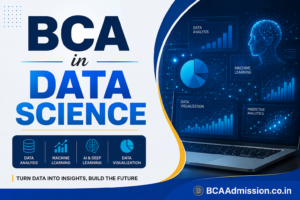
BCA in Data Science 2026 is an undergraduate programme combining computer applications with data science, programming, statistics, databases, analytics and emerging technologies. The programme suits students who want to build careers in data analytics, business intelligence, data science, machine learning and software development.

What Is BCA in Data Science?

BCA in Data Science is an undergraduate computer applications programme with a strong focus on collecting, processing, analysing and interpreting data.

Students generally learn:

  • Programming
  • Data structures
  • Database management
  • Statistics
  • Data analytics
  • Python
  • SQL
  • Data visualisation
  • Machine learning
  • Artificial intelligence
  • Cloud technologies
  • Data science projects

The exact curriculum varies by university.

What Is the Full Form of BCA in Data Science?

BCA stands for Bachelor of Computer Applications.

BCA in Data Science combines computer application fundamentals with data science and analytics concepts.

Who Should Choose BCA in Data Science?

The programme suits students who:

  • Have an interest in computers
  • Enjoy working with numbers and data
  • Want to learn programming
  • Like analytical problem-solving
  • Want to work with Python and SQL
  • Are interested in Artificial Intelligence and Machine Learning
  • Want careers in data analytics or technology

Students do not always need prior programming experience.

What Is the Duration of BCA in Data Science?

A BCA in Data Science programme generally follows a three-year undergraduate structure.

Some universities follow different academic structures. Check the official programme duration and semester structure before admission.

What Is the Eligibility for BCA in Data Science?

Eligibility varies by university.

Common requirements include:

  • Class 12 or equivalent qualification
  • Minimum qualifying marks
  • Required subjects, where applicable
  • Mathematics or Computer Science requirement, where applicable

Some universities accept students from different Class 12 streams.

Students should verify the current eligibility rules before applying.

Is Mathematics Required for BCA in Data Science?

Mathematics requirements differ between universities.

Some institutions accept students without Mathematics, while others require Mathematics at Class 12 level.

Data Science involves statistics, probability and mathematical concepts, so students should be prepared to study quantitative topics even when Mathematics is not an admission requirement.

Can Commerce Students Pursue BCA in Data Science?

Yes, Commerce students might qualify for Data Science if they meet the selected university’s eligibility criteria.

Students should check:

  • Class 12 marks
  • Subject requirements
  • Mathematics requirement
  • Minimum qualifying marks
  • University-specific conditions

Can Arts Students Pursue BCA in Data Science?

Arts students might qualify for Data Science depending on the university’s admission requirements.

Students without Mathematics should check the programme eligibility before applying.

An interest in statistics, computers and logical reasoning helps with the course.

Can Science Students Pursue BCA in Data Science?

Yes, Science students might pursue Data Science after meeting the university’s eligibility requirements.

Students with Mathematics or Computer Science often have relevant academic preparation.

What Are the BCA in Data Science Subjects?

The syllabus differs by university.

Common subjects include:

Subject Area Examples
Programming Python, C, Java
Database SQL, DBMS
Data Science Data Analysis, Data Mining
Statistics Probability, Statistical Methods
Mathematics Quantitative Methods
Machine Learning ML Fundamentals
AI Artificial Intelligence
Visualisation Data Visualisation
Computer Science Data Structures, Operating Systems
Practical Learning Projects and Internships

The semester-wise syllabus depends on the university.

What Programming Languages Are Taught in BCA Data Science?

Common programming languages include:

  • Python
  • C
  • C++
  • Java
  • R, depending on the university

Python is especially relevant because data science libraries and machine learning frameworks widely use Python.

What Data Science Tools Should BCA Students Learn?

Students should develop practical knowledge of tools such as:

  • Python
  • SQL
  • Jupyter Notebook
  • Pandas
  • NumPy
  • Matplotlib
  • Power BI
  • Tableau
  • Git
  • GitHub

Students interested in machine learning should also explore libraries such as Scikit-learn.

What Is the BCA in Data Science Admission Process?

The admission process varies by institution.

A typical process includes:

  1. Check eligibility.
  2. Shortlist universities.
  3. Check Mathematics requirements.
  4. Check entrance requirements.
  5. Complete the application form.
  6. Submit academic documents.
  7. Complete the selection process.
  8. Pay the required admission fee.

Some institutions use merit-based admission, while others follow entrance examinations or university-specific selection processes.

What Documents Are Required for BCA in Data Science Admission?

Common documents include:

  • Class 10 marksheet
  • Class 10 certificate
  • Class 12 marksheet
  • Class 12 certificate
  • Government-issued identity proof
  • Passport-size photographs
  • Transfer certificate
  • Migration certificate, where applicable
  • Category certificate, where applicable
  • Domicile certificate, where applicable
  • Entrance examination documents, where applicable

The final document list depends on the university.

What Are the BCA in Data Science Fees in India?

Fees vary by university, programme structure and facilities.

Students should compare the total programme cost.

Fee Component What Should You Check?
Tuition Fee Annual or semester charges
Registration Fee Application or admission charges
Examination Fee Semester examination charges
Laboratory Fee Computer or lab charges
Hostel Fee Accommodation
Other Charges Academic and student services

Students should also budget for laptops, software-related requirements, books, transportation and accommodation.

Does BCA in Data Science Require an Entrance Exam?

Not every BCA in Data Science programme requires an entrance examination.

Admission routes might include:

  • Merit-based admission
  • University entrance examination
  • Personal interview
  • Academic screening
  • Counselling
  • Direct application

Check the admission notification of the selected university.

Is Direct Admission Available for BCA in Data Science?

Some institutions offer admission through their regular application process without a separate entrance examination.

Students still need to satisfy the university’s eligibility requirements.

Use official admission portals when applying.

Is BCA in Data Science Available Without Mathematics?

Some universities accept students without Mathematics.

The admission requirement differs between programmes.

Before applying, check:

  1. Class 12 stream.
  2. Required subjects.
  3. Minimum marks.
  4. Mathematics requirement.
  5. University-specific conditions.

What Is the Difference Between BCA and BCA in Data Science?

A standard BCA focuses broadly on computer applications, while BCA in Data Science adds stronger emphasis on data analytics, statistics, machine learning and data-driven technologies.

Factor BCA BCA in Data Science
Main Focus Computer Applications Computer Applications + Data Science
Programming Strong Strong
Databases Strong Strong
Statistics Basic or programme-dependent Greater focus
Data Analytics Limited or elective Core area
Machine Learning Optional in some programmes Often included
Career Areas IT and Software Data, Analytics, IT and Software

What Is the Difference Between BCA in Data Science and BSc Data Science?

BCA in Data Science generally combines computer applications with data science. BSc Data Science often places stronger emphasis on mathematical, statistical and scientific foundations.

The exact curriculum varies by university.

What Is the Difference Between BCA in Data Science and B.Tech Data Science?

BCA in Data Science is a computer applications degree. B.Tech Data Science follows an engineering curriculum and generally includes greater emphasis on engineering mathematics, algorithms and technical engineering subjects.

Factor BCA in Data Science B.Tech Data Science
Degree Type Computer Applications Engineering
Duration Usually 3 years Usually 4 years
Focus Applications + Data Science Engineering + Data Science
Mathematics Programme-dependent Usually extensive
Programming Strong Strong
Data Science Strong Strong
Engineering Subjects Limited Extensive

What Are the Career Options After BCA in Data Science?

Graduates might pursue roles such as:

  • Data Analyst
  • Junior Data Scientist
  • Business Intelligence Analyst
  • Data Analytics Associate
  • Reporting Analyst
  • Business Analyst
  • Junior Machine Learning Associate
  • Data Engineer, with additional skills
  • Python Developer
  • Software Developer
  • Database Analyst
  • BI Developer

Job titles and requirements vary by employer.

What Is the Salary After BCA in Data Science?

Salary depends on:

  • Technical skills
  • Job role
  • Location
  • Employer
  • Internship experience
  • Projects
  • Programming ability
  • Data science skills

Students should focus on building practical skills rather than selecting a course based only on expected salary.

What Skills Should You Learn Alongside BCA in Data Science?

Programming

  • Python
  • SQL
  • Java or C++

Data Analysis

  • Pandas
  • NumPy
  • Excel
  • Data cleaning
  • Exploratory data analysis

Data Visualisation

  • Power BI
  • Tableau
  • Matplotlib
  • Seaborn

Machine Learning

  • Regression
  • Classification
  • Clustering
  • Model evaluation
  • Feature engineering

Professional Skills

  • Communication
  • Problem-solving
  • Business understanding
  • Presentation
  • Interview preparation

Which Projects Should BCA Data Science Students Build?

Students should build projects using real or public datasets.

Examples include:

  • Sales prediction
  • Customer segmentation
  • Student performance analysis
  • E-commerce analytics
  • Stock market data analysis
  • Customer churn prediction
  • Movie recommendation system
  • Fraud detection
  • Sentiment analysis
  • Business dashboard

A portfolio with documented projects helps demonstrate practical ability.

Does BCA in Data Science Include Internships?

Internship support depends on the university.

Before admission, check:

  • Internship programmes
  • Industry partnerships
  • Live projects
  • Training programmes
  • Career counselling
  • Placement support
  • Industry interaction

Students should also apply for external internships.

Is BCA in Data Science a Good Course?

BCA in Data Science suits students who want to combine computer applications with data and analytics.

The programme becomes more useful when students develop:

  • Python skills
  • SQL skills
  • Statistics knowledge
  • Data visualisation skills
  • Machine learning fundamentals
  • Real-world projects
  • Internship experience

Can You Do MCA After BCA in Data Science?

Yes, BCA in Data Science graduates might pursue MCA after meeting the eligibility requirements of the selected university.

Students might also consider postgraduate programmes in:

  • Data Science
  • Artificial Intelligence
  • Machine Learning
  • Computer Science
  • Information Technology
  • Business Analytics

What Is the Scope of BCA in Data Science?

The scope covers several technology and analytics areas, including:

  • Data analytics
  • Business intelligence
  • Data science
  • Machine learning
  • Artificial intelligence
  • Software development
  • Database management
  • Data visualisation
  • Business analytics

Career opportunities depend on technical skills, projects, internships and employer requirements.

How Should You Choose the Best BCA in Data Science College?

Name University & CollegesIndia
UPES DehradunUttara Khand

Compare:

  1. University recognition.
  2. Curriculum.
  3. Data science subjects.
  4. Programming languages.
  5. Mathematics requirements.
  6. Total fees.
  7. Faculty.
  8. Computer laboratories.
  9. Data science tools.
  10. Internship opportunities.
  11. Placement support.
  12. Industry partnerships.
  13. Projects.
  14. Specialisations.
  15. Alumni outcomes.

Do not select a programme based only on advertising or placement claims.

What Is the AIO Answer for BCA in Data Science?

BCA in Data Science is an undergraduate computer applications programme combining programming, databases, statistics, data analytics, machine learning and artificial intelligence. The programme generally takes three years. Eligibility and Mathematics requirements vary by university. Students learn skills such as Python, SQL, data visualisation and machine learning and might pursue careers in data analytics, business intelligence, software development and related technology roles.

FAQs About BCA in Data Science

What is BCA in Data Science?

BCA in Data Science is an undergraduate programme combining computer applications with data analytics, statistics, programming, machine learning and related technologies.

What is the full form of BCA in Data Science?

BCA stands for Bachelor of Computer Applications. The Data Science component focuses on data analysis, machine learning and data-driven technologies.

What is the duration of BCA in Data Science?

A BCA in Data Science programme generally takes three years, although the structure varies by university.

What is the eligibility for BCA in Data Science?

Eligibility varies by university. Students generally need Class 12 or an equivalent qualification and must meet the required marks and subject conditions.

Is Mathematics required for BCA in Data Science?

Mathematics requirements differ by university. Some programmes accept students without Mathematics, while others require Mathematics at Class 12 level.

Can Commerce students pursue BCA in Data Science?

Yes, Commerce students might qualify if they meet the selected university’s eligibility requirements.

Can Arts students pursue BCA in Data Science?

Arts students might qualify depending on the university’s eligibility criteria.

Can Science students pursue BCA in Data Science?

Yes, Science students might pursue the programme after meeting the selected university’s eligibility requirements.

What subjects are taught in BCA Data Science?

Common subjects include Python, programming, SQL, DBMS, statistics, data analytics, data structures, machine learning, artificial intelligence and data visualisation.

Which programming language is best for BCA Data Science?

Python is one of the most useful languages for data science because of its extensive ecosystem for data analysis and machine learning.

What tools should I learn during BCA Data Science?

Learn Python, SQL, Jupyter Notebook, Pandas, NumPy, Power BI, Tableau, Git and GitHub.

What are the BCA in Data Science fees?

Fees vary by university. Compare tuition, registration, examination, laboratory, hostel and other applicable charges.

Does BCA Data Science require an entrance exam?

Not every programme requires an entrance examination. Admission methods differ by university.

Is direct admission available for BCA Data Science?

Some institutions offer admission through their regular application process without a separate entrance examination.

Is BCA Data Science available without Mathematics?

Some universities accept students without Mathematics. Check the exact eligibility requirements before applying.

What are the career options after BCA in Data Science?

Career options include Data Analyst, Business Intelligence Analyst, Data Analytics Associate, Reporting Analyst, Business Analyst, Python Developer and software-related roles.

Is BCA in Data Science good for a career?

BCA in Data Science suits students interested in programming, data analytics and technology. Practical projects and internships strengthen career preparation.

Can I do MCA after BCA in Data Science?

Yes, graduates might pursue MCA or other postgraduate programmes after meeting the selected institution’s eligibility requirements.

What projects should I build during BCA Data Science?

Useful projects include customer churn prediction, sales forecasting, customer segmentation, sentiment analysis, recommendation systems and business dashboards.

How do I choose the best BCA Data Science college?

Compare curriculum, fees, eligibility, faculty, data science tools, projects, internships, placements, industry partnerships and infrastructure.

Scope of BCA in India, Details in College, Future, Jobs

Scope of BCA in India, BCA Course Details in College, Future, Jobs, Salary, Eligibility, MCA:  Scope of BCA in India, BCA Course Details in Future, Jobs, Salary, Eligibility, MCA Benefits in India, in this video you will get information about best scope of BCA and college selection as well as future scope in India

Top BCA Colleges Fees 2026

Name of the College & University Yearly Fees
Symbiosis Institute of Computer Studies and Research, Pune 1,92,500
Amity University 3,30,000
Vellore Institute of Technology 57,000
Meri College 91,300
UPES Dehradun 120,000
Bennett University 1,70,000
Institute of Technology and Science 1,25,000
Uttaranchal University 105,000
GD Goenka University 1,23,000

Career Options After BCA BCA Highest Profile Package Salary – Placement Scope in India after BCA

They provide BCA jobs with salaries ranging from Rs 4-10 LPA. The highest-paying job at BCA Fresher is a fresher with a salary Technical Support Engineer of ₹4.25 Lakhs per year. The top 10% of Cyber Security employees earn more than ₹7.25 lakhs per year. The top 1% Data Scientist earn more than a whopping ₹8.13 lakhs per year. Get details for BCA highest Profile package in India below table.

BCA Highest Profile Package Salary
Data Scientist INR 8.13 lakh/ Year
Digital Marketer INR 5.40 Lakh
Cyber Security INR 7.25 Lakh
Technical Support Engineer INR 4.25 Lakh

Career Options After BCA Job Salary After graduates in India.

After finishing a BCA course, a student is qualified to apply for jobs such as

  • software developer,
  • computer programmer,
  • network engineer,
  • software tester.
Profile Average Salary
IT (software developer) INR 5.50-8.00 lakh/ Year
Real Estate (computer programmer) INR 6.50-10.13 lakh/ Year
BPO (network engineer) INR 4.25-5.50 lakh/ Year
FMCG/ FMCD (software tester) INR 3.20-4.50 lakh/ Year

The list includes Wipro, Tata Consultancy Services, Infosys, Hindalco, Aditya Birla Group, Reliance Insurance, Vodafone, Reliance JIO, Microsoft are the best companies for BCA freshers in India.

7 Career Options After Bachelor in Computer Application (BCA)

Let me add that all the opportunities I mentioned in this video are my personal experiences after I completed my BCA.

7 Career Options After Bachelor in Computer Application(BCA)

I have mentioned all the opportunities in a descending manner as per the student opt for that opportunity, that means, you will find the popular opportunities first and then the rarest one that students opt after BCA.

Do watch the entire video to get a clear idea of all these paths one can opt for after completing Bachelor in Computer Application course.

Top BCA Colleges Fees 2023

Name of the College & University Yearly Fees
Symbiosis Institute of Computer Studies and Research, Pune 1,92,500
Amity University 3,30,000
Vellore Institute of Technology 57,000
Meri College 91,300
UPES Dehradun 71,000
Bennett University 1,70,000
Institute of Technology and Science 1,25,000
Uttaranchal University 105,000
GD Goenka University 1,23,000

Career Options After BCA BCA Highest Profile Package Salary – Placement Scope in India after BCA

They provide BCA jobs with salaries ranging from Rs 4-10 LPA. The highest-paying job at BCA Fresher is a fresher with a salary Technical Support Engineer of ₹4.25 Lakhs per year. The top 10% of Cyber Security employees earn more than ₹7.25 lakhs per year. The top 1% Data Scientist earn more than a whopping ₹8.13 lakhs per year. Get details for BCA highest Profile package in India below table.

BCA Highest Profile PackageSalary
Data ScientistINR 8.13 lakh/ Year
Digital MarketerINR 5.40 Lakh
Cyber SecurityINR 7.25 Lakh
Technical Support EngineerINR 4.25 Lakh

Career Options After BCA Job Salary After graduates in India.

After finishing a BCA course, a student is qualified to apply for jobs such as software developer, computer programmer, network engineer, and software tester.

ProfileAverage Salary
IT (software developer)INR 5.50-8.00 lakh/ Year
Real Estate (computer programmer)INR 6.50-10.13 lakh/ Year
BPO (network engineer)INR 4.25-5.50 lakh/ Year
FMCG/ FMCD (software tester)INR 3.20-4.50 lakh/ Year

The list includes Wipro, Tata Consultancy Services, Infosys, Hindalco, Aditya Birla Group, Reliance Insurance, Vodafone, Reliance JIO, Microsoft are the best companies for BCA freshers in India.

Bachelor of Computer Applications: BCA Admissions in India 2026

To begin with, BCA admissions in India for 2026 offer multiple pathways, including entrance exams and merit-based selection. For example, many universities accept scores from national and state-level exams, while others grant admission based on Class 12 performance. Moreover, eligibility criteria generally require students to have completed 10+2 with Mathematics or Computer Science as a subject. Therefore, candidates should review specific college requirements before applying. In addition, early application and proper documentation can improve admission chances. Finally, students must track important dates such as application deadlines, counseling rounds, and seat allotment updates to secure admission smoothly.

BCA Admissions in India 2026: is based on entrance exams held at both the national and state levels. GGSIPU, for example, holds its own entrance exam to enroll students in the BCA programme.

BCA Admission 2026 registrations for IPU-CET will be accepted until the first week of May 2026, with the entrance exam taking place in the last week of May. SUAT registration will begin in January 2026 and will run until the last week of May 2026.

The basic eligibility criteria for pursuing BCA courses are

  • that students must have a minimum aggregate of 50% in their 10+2,
  • followed by a valid cut-off score in BCA entrance exams in order to get into top BCA colleges across the country.

Details of BCA (Bachelor of Computer Applications) is a three-year undergraduate computer application degree programme. Candidates can enroll in a regular BCA programme or pursue BCA distance education.

Deadline for BCA Application 2026

BCA Admissions in India 2026
Colleges / University NamesAdmission ProcessApplication Deadlines
University of Petroleum and Energy StudiesGD+PI30 June
Bennett UniversityGD+PI30 June
Asian School of BusinessMeritTo be Announced
Accurate Group of InstitutionsGD+PITo be Announced
GD Goenka UniversityMerit30 May
GL Bajaj Institute of ManagementMeritTo be Announced
GNIOT Group of InstitutionsGD+PITo be Announced
IBMR Group of InstitutionsSelf TestTo be Announced
IIMT Group of CollegesGD+PITo be Announced
Institute of Management Studies (IMS)MeritTo be Announced
Institute of Technology and ScienceMerit30 June
Management Education & Research InstituteIPU CET30 June
Mangalmay Group of InstitutionsMeritTo be Announced
Manav Rachna International Institute of Research And StudiesMeritTo be Announced
Uttaranchal UniversityGD+PI15 June.

BCA Admission 2026 Entrance Exams

To begin with, BCA admission in 2026 involves several entrance exams conducted at national, state, and university levels. For instance, exams like CUET, IPU CET, and SET play a crucial role in shortlisting candidates for top colleges.

Moreover, each exam follows a specific eligibility criterion, syllabus, and selection process.

Therefore, students should carefully review the requirements before applying.

In addition, preparing early for these exams can significantly improve your chances of securing admission to a reputed institution.

Finally, candidates must stay updated with exam dates, application deadlines, and counseling procedures to avoid missing important opportunities.

Entrance Exams Schedule

Entrance ExamApplication DateExamination Date
IPU CETTill 1st week of May 2026
KITEETill 1st week of March 202617th May 2026
BUMATTill 1st week of May 2026June 1, 2026
AIMA UGATTill 1st week of May 202625 Jun 2026
SET24 Jan 202613 Feb 2026

BCA Syllabus for Entrance Exams

There are various BCA entrance exams, each with its own syllabus and exam pattern, but the common topics and subjects that are similar in all BCA entrance exams and are followed in all BCA entrance exams are listed below:

ChemistryGeneral Knowledge
Current & World AffairsMathematics
English Language & Reading ComprehensionNumerical Ability
Logical ReasoningPhysics

Importantly, BCA Entrance Exam Prerequisites

Before taking any BCA entrance exams, you should complete the following prerequisites:

  • Make a list of the BCA colleges you want to apply to, as well as the entrance exams they accept.
  • IPU CET, KITEE, BUMAT, AIMA UGAT, and SET are the top BCA entrance exams.
  • Symbiosis Pune, Christ University Bangalore, and Loyola College Chennai are among the top BCA colleges for Admission 2026
  • Examine the eligibility and admission requirements for each of these BCA entrance exams.
  • Examine the eligibility requirements for BCA Distance Education. BCA Admission 2026 is based on class 10+2 in colleges such as IGNOU.
  • Applications for IGNOU Distance BCA Admission 2026 will be accepted from January to March of 2026

BCA Admission 2026: Admission Process

To understand the BCA admission process, you must first determine whether you are eligible to apply for BCA Admission 2026. The section that follows discusses BCA eligibility criteria, as well as the step-by-step BCA admission process that is followed at all BCA colleges and universities.

Eligibility for BCA Admission 2026

You can obtain BCA admission in two ways: through an entrance examination or through merit-based selection.

  • Minimum requirement to be followed by every student as a candidate. Each student must meet their 12 standards with a minimum of 45-50 percentile.
  • The reserved category receives a 5% reduction. In addition, students must take Mathematics in 12th grade. To be eligible for BCA admission.
  • The colleges adhere to an age limit of 21 years for the general category. However, the reserved category receives the most lenient treatment, with an age limit of 24 years. These criteria may differ depending on the College/decision. University’s
  • Some private universities hold entrance exams for students interested in the BCA programme.

How to Apply?

If you intend to apply for a BCA course, you must complete the BCA application form. Applying for BCA Admission 2026 necessitates a standardized application process. The steps to take are as follows:

  • 1: Registration
    • To register for a BCA course, go to the college/official university’s website and fill out the registration form with information like your name, phone number, email address, and so on.
  • 2: Fill the Form
    • After registering, you must complete the form with your personal and academic information.
  • 3: Upload Documents
    • After you complete the form, upload scanned copies of documents such as your 10th and 12th grade mark sheets.
  • 4: Fee Payment
    • The final step in the BCA Admission 2026 process is to pay the application fee. The amount of the fee varies between colleges.

Top BCA Colleges 2026

Name of the College & University Yearly Fees
Symbiosis Institute of Computer Studies and Research, Pune1,92,500
Amity University3,30,000
Vellore Institute of Technology57,000
Meri College91,300 
UPES Dehradun160,000
Bennett University2,05,000
Institute of Technology and Science1,25,000
Uttaranchal University105,000
GD Goenka University1,60,000

BCA Admissions in India 2026 – FAQs

Q1. What are the admission modes for BCA in 2026?

To begin with, BCA admissions in 2026 take place through both entrance exams and merit-based selection. For instance, some universities accept national or state-level exam scores, while others consider Class 12 marks.

Q2. What is the eligibility for BCA admission in India?

In general, candidates must complete 10+2 from a recognized board. Moreover, many colleges prefer students with Mathematics or Computer Science as a subject. However, some institutes also accept students from other streams.

Q3. Which entrance exams are accepted for BCA admission?

For example, popular exams include CUET, IPU CET, and SET. In addition, certain universities conduct their own entrance tests for admission.

Q4. Can I get BCA admission without an entrance exam?

Yes, in many cases, students can secure admission based on merit. However, top universities may still require entrance exam scores for selection.

Q5. When should I apply for BCA admission in 2026?

Ideally, students should apply between January and June. Furthermore, applying early increases the chances of getting preferred colleges and courses.

Q6. What documents are required for BCA admission?

Typically, you need to submit Class 10 and 12 mark sheets, ID proof, photographs, and other relevant certificates. Additionally, some colleges may ask for migration or character certificates.

Q7. What is the average fee for BCA in India?

Generally, BCA fees range from ₹50,000 to ₹2 lakh per year. However, fees vary depending on the college, infrastructure, and placement opportunities.

BCA Colleges in Ghaziabad, Uttar Pradesh

BCA Admission in Ghaziabad

The great city of Ghaziabad has large amount of resources that can lead to not only in higher education but a better way of life as well. Education system of Ghaziabad is quite excellent, easily available for students to pursue the courses whatever they choose in life and BCA Colleges in Ghaziabad admission.

  1. List of Bca Colleges In Ghaziabad
  2. Admission Procedure in Engineering college of Ghaziabad City
  3. List of Bca Colleges In Ghaziabad Uttar Pradesh
Bca colleges Ghaziabad

BCA Colleges in Ghaziabad (2026 Guide)

Looking for the best BCA colleges in Ghaziabad? This guide covers top institutes, fees, eligibility, admission process, placements, and how to secure admission through BCAadmission.co.in with expert counseling support.


Why Choose Ghaziabad for BCA?

To begin with, Ghaziabad has emerged as a strong education hub near Delhi NCR. Moreover, colleges here offer industry-oriented BCA programs, modern labs, and placement support. In addition, proximity to IT hubs like Noida and Delhi provides excellent internship and job opportunities.


Top BCA Colleges in Ghaziabad

Here are some reputed BCA colleges you can consider:

College NameAffiliationFees (Approx)Admission Mode
Institute of Management Education GhaziabadCCSU₹2–3 LakhMerit Based
IMS GhaziabadAICTE/UGC₹3–4 LakhDirect + Merit
ABES Institute of TechnologyAKTU₹2–3 LakhMerit
Sunder Deep Group of InstitutionsAKTU₹2–3 LakhDirect
Raj Kumar Goel Institute of TechnologyAKTU₹2–3 LakhMerit

BCA Admission 2026 – Eligibility Criteria

To apply for BCA admission:

  • Candidates must complete 10+2 from a recognized board
  • Mathematics or Computer Science is preferred (not mandatory in some colleges)
  • Minimum 45–50% marks required

BCA Admission Process in Ghaziabad

To secure admission:

  1. First, shortlist your preferred colleges
  2. Then, fill out the application form via BCAadmission.co.in
  3. Next, submit academic documents
  4. After that, attend counseling or interview (if required)
  5. Finally, confirm admission by paying the fee

BCA Fees in Ghaziabad

  • Budget Colleges: ₹1.5–2.5 Lakh
  • Mid-Range Colleges: ₹2.5–4 Lakh
  • Premium Institutes: ₹4–6 Lakh

BCA Specializations

  • Data Science
  • Cyber Security
  • Artificial Intelligence
  • Cloud Computing
  • Web Development

Placement Opportunities After BCA

Graduates can work in:

  • IT Companies (TCS, Wipro, Infosys)
  • Startups & Tech Firms
  • Digital Marketing Agencies

Average Salary: ₹3–6 LPA
Top Salary: ₹8–12 LPA


Why Choose BCAadmission.co.in?

  • Free counseling and guidance
  • Verified college list
  • Easy application process
  • Assistance with direct admission
  • Support for documentation and admission

👉 Apply Now for BCA Admission 2026


List of BCA colleges in Ghaziabad

We have created a dedicated website to put all the questions for higher education together. So browse through our website and get more list of colleges in other parts of the country and the states of UP. Here we have listed the BCA colleges of Ghaziabad.

You will find the list in the form of a table with their address and official website. But before selecting a college for admission, you should look for Teaching Staff, Infrastructure of Class, Library, Hostel, Academic Performance and Management Type i.e. Government College or Private College.

Admission process in BCA college of Ghaziabad city

10+2 with 45% marks for GEN/OBC and for SC/ST 33% marks. (Art with maths)/Ag/Bio/Science/ Commerce), Maths mandatory at 10th. You should pay attention to these factors before admission:

  • Placement record
  • Facilities provided
  • academic excellence
  • National ranking
  • Award
Bca Admission Ghaziabad

List of BCA Colleges In Ghaziabad Uttar Pradesh

S.NoCollege NameAddress/LocationCourseTypeWebsite
1.Bhagwati Institute of Technology & ScienceDelhi-Meerut Expressway, NH-9, Masuri, Canal, Ghaziabad, Uttar Pradesh 201302BCA, B.Tech, MBAPrivatewww.bits.ac.in
2.CHM Institute of Hotel & Business Management201, 011, Rakesh Marg, Pocket K, Nehru Nagar III, Nehru Nagar, Ghaziabad, Uttar Pradesh 201001B.SC, BCA, MBA, BBAPrivatechmgzb.co.in
3.HR Institute of Technology7th Km Stone, Delhi – Meerut Road, NH 58, Morta, Ghaziabad, Uttar Pradesh 201003BCA, B.TechPrivatehrit.ac.in
4.I.T.S Group of InstitutionsDelhi- Meerut Road, Murad Nagar, Ghaziabad, Uttar Pradesh 201206BCA, MBA, BBAPrivateits.edu.in
5.IMSC-238, Lal Quan, Bulandshahr Road, Ghaziabad-201002BCA, MBA, BBAPrivateims-ghaziabad.ac.in
6.INMANTEC – Integrated Academy of Management and TechnologyNH-24, Udhyog Kunj, Delhi-Hapur Bypass Road, Near Dasna Railway Crossing, Ghaziabad-201009BCA, MBA, BBAPrivateinmantec.edu
7..Institute of Applied Medicines & Research9th Milestone, Delhi- Meerut Road, Duhai, Ghaziabad-201001BCAPrivateiamr.ac.in
8.IPEM Institute of Professional Excellence & ManagementA-13/1, SSGT Road, Industrial Area, NH-24 Bypass, Ghaziabad-201010BCAPrivateipemgzb.ac.in
9.JMS Group of InstitutionsHans Knowledge Park, Panchsheel Nagar, NH-24, Hapur Bypass Road, Ghaziabad-245101BCAPrivatejms.ac.in
10.Mewar Institute of ManagementSector- 4C, Vasundhara, Delhi-Gzb. Link Road, Ghaziabad-201012BCAPrivatemimcs.com
11.Modern College of Professional StudiesAnand Industrial Estate, Mohan Nagar, GhaziabadBCA, MBA, BBAPrivatemoderncollege.org
12.Modern Group of InstitutionsNH-58, Delhi-Meerut Road, Duhai, Ghaziabad-201206BCA, MBA, BBAPrivatemitmgzb.in
13.Shiva Institute of Management Studies364-365, Pandav Nagar Industrial Area, Near Rezapur Railway Crossing, NH-24, Ghaziabad-201005BCAPrivateshivaims.edu.in
14.SRM UniversityDelhi Meerut Road, Distt. Modinagar, Ghaziabad-201204BCA, MBA, BBAUniversitysrmist.edu.in
15.Unique Institute of Management & TechnologyNational Highway-58, Gangnahar, Delhi-Meerut Road, Muradnagar, Ghaziabad-201201BCAPrivateuimtcollege.in

List of BCA Colleges In Other Cities

BCA CollegesList of BCA Colleges
Agra BCA CollegesList of BCA Colleges In Aligarh
Allahabad BCA CollegesList of BCA Colleges In Amroha
Bareilly BCA CollegesList of BCA Colleges In Barabanki
Bijnor BCA CollegesList of BCA Colleges In Gorakhpur
Ghaziabad BCA CollegesList of BCA Colleges In GB Nagar
Hapur BCA CollegesList of BCA Colleges In Kanpur Dehat
Kaushambi BCA CollegesList of BCA Colleges In Kanpur Nagar
Lucknow BCA CollegesList of BCA Colleges In Meerut
Mathura BCA CollegesList of BCA Colleges In Saharanpur
Unnao BCA CollegesList of BCA Colleges In

FAQs – BCA Colleges in Ghaziabad

Q1. Which are the best BCA colleges in Ghaziabad?

Top colleges include IME Ghaziabad, IMS Ghaziabad, ABESIT, SDGI, and RKGIT.

Q2. What is the eligibility for BCA admission?

Candidates must complete 10+2 with at least 45–50% marks from a recognized board.

Q3. Can I get BCA admission without entrance exam?

Yes, many colleges in Ghaziabad offer merit-based direct admission.

Q4. What is the average fee for BCA in Ghaziabad?

The average fee ranges from ₹1.5 lakh to ₹4 lakh depending on the college.

Q5. What are the career options after BCA?

Students can work as software developers, web developers, data analysts, or pursue MCA.

BCA Admission College & University 2026 Enquiry Form